
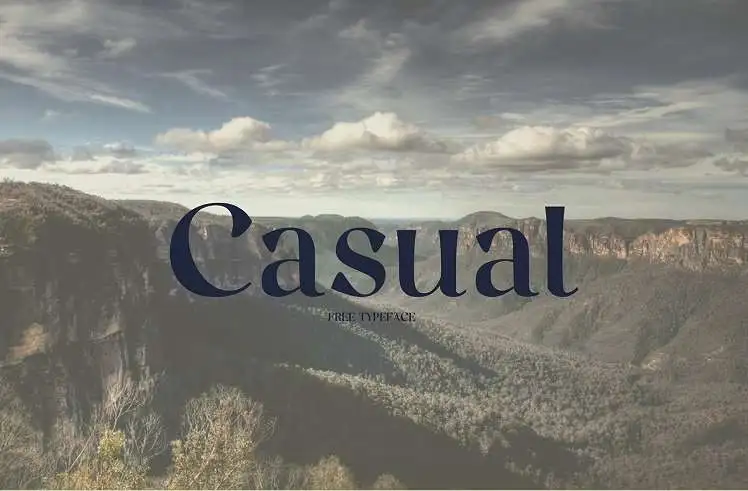

About Casual Font
I first tried Casual Font while working on a small print zine for a local art group. I needed something calm, readable, and a bit relaxed, but not silly or loud. The name caught my eye, yet I was unsure if it would feel too playful for body text.
Once I set a few sample pages, the typeface started to make sense. It felt like a friendly book face with a softer edge. I tested it across headings, pull quotes, and captions, then wrote up my notes for Free Fonts Lab so other designers could see where it shines and where it struggles.
Font Style & Design Analysis
Casual Font is a serif typeface with a gentle, informal voice. The serifs are not sharp or rigid; they have a slight softness that keeps the font from feeling strict. Strokes look balanced rather than high contrast, so the text sits quietly on the page without drawing too much attention to itself.
The designer is unknown, and that shows a bit in how the font family is built. It feels like a focused single style rather than a large professional system. There are no extra optical sizes or dramatic alternates. What you get is a straightforward regular weight that tries to cover everyday reading tasks.
The letterforms have open counters and simple curves, which helps with legibility at medium sizes. Spacing is on the loose side, giving the text a relaxed rhythm but sometimes making long lines feel airy. The mood sits between friendly and neutral. It works best when you do not ask it for strong personality. As a serif option, it supports calm reading, but complex editorial layouts may reveal its limits in tight columns or dense copy.
Where Can You Use Casual Font?
I see Casual Font working well in small community print projects, lightweight branding, and simple editorial layouts. At larger sizes, like section headings or posters, the details hold up, though the font style stays quite modest. It will not carry a loud brand on its own, but it can support a soft visual identity.
At body text sizes around 11–12pt, the serif forms read cleanly, especially with generous line spacing. On screen, it is usable, though not as sharp as some more modern book faces. I would trust it for short articles, brochures, manuals, school newsletters, or reading materials aimed at a general audience that values clarity over flair.
For pairings, I like setting Casual Font as the main serif text and matching it with a simple geometric sans-serif for headings or UI labels. Keeping layouts open, with good margins, helps its airy spacing feel intentional. I would avoid pairing it with very ornate scripts or heavy display fonts, as they can overpower its quiet tone quite fast.
Font License
The licence terms for Casual Font can change, and they may differ between personal and commercial use. I strongly suggest checking the current licence on the official source before using it in client work, apps, or large print runs. I treat it as a trial tool until I confirm those details.
My honest takeaway as Ayan Farabi: Casual Font is a gentle, readable serif that works when you need a relaxed, low-drama text face, as long as you respect its limits and test it carefully in real layouts.







Leave a Reply